Should You Leave Your Exterior Lights on Overnight?
December 6, 2025
by Pat Shea
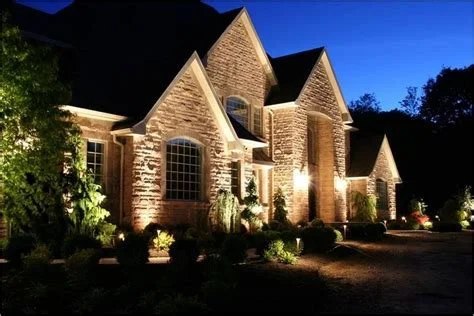
Exterior Lighting
Cabernet Watch has promoted the use of Overnight Exterior Lighting for years. Exterior lighting plays a significant role in establishing a secure environment around your home. We refer to the sewcure environment as ‘Target Hardening’. Outdoor lighting is a single issue in the overall strategy of Target Hardening.
Target hardening techniques start with messaging. We need to make the criminal understand that you are prepared and have already considered the possibility of an intrusion. Alarm systems are great for intrusion detection. However, the intrusion has already happened when the alarm siren sounds.
The sign the alarm company gave you is the tool that sends the message that this home will be more difficult to Break & Enter. Today technologies improve your target hardening efforts. Many developers are including the system in new homes. Be aware: Alarms do nothing if you don’t use them or if they don’t work.
Exterior lights deter an incursion before it happens. I recently read an article about the use of exterior light and their impact on security of the home overnight. Here is the link to that article:
I have addressed this issue several times in meetings and internet articles. Cabernet Watch, National Neighborhood Watch and the National Sheriff’s Association are in favor of use of Overnight Exterior Lighting.
Look Out for Each Other
So when is it appropriate to leave your exterior lights on?
Late evening deliveries
The sun sets about 4:30 pm each day at this time of year. Amazon, UPS and other agencies will be delivering until later in the evening when it is already dark. Lighting the pathway to the area deliveries occur is a great idea to improve safe physical access to your property. You don’t want the delivery driver to trip and fall on your property.
Returning after dark
Holiday parties generally start after work in the next two weeks before Christmas. Whether you imbibed or not during the party, you will be returning home to a dark house if you have not arranged to have your exterior lights illuminated. This is one of the primary uses of the exterior lighting installed by the builder on your home. There are several good ways to manage exterior lights. Personally, I changed out the light switch for a timer on my lights. The timer program manages the lights ON at Dusk and OFF at Dawn. The device is available from Honeywell for well under $50. Honeywell Home 7-Day Programmable Light Switch Timer
Improves security
Whether you leave exterior lights on all night depends on the placement and timing. Some lights—like motion lights—enhance security, while others—like constant porch lights—detract from it. The timer mentioned above is one of the best ways to help. This timer has 2 embedded modes , Dusk-to-Dawn mode, or Random mode. Random mode changes the lighting profile of the home overnight to prevent observers from getting too comfortable about the access to your home.
Cabernet Watch is a member of National Neighborhood Watch
and the National Sheriff’s Association
Why You Shouldn’t Leave Certain Exterior Lights
Some lights defeat home security
It's important to strike the right balance, poorly place lights can actually have the opposite effect, inadvertently drawing attention to potential entry points for intruders. If outdoor lighting is the only security measure in your plan, it might give you, the homeowner, a false sense of safety. That’s why I always recommend pairing lighting with other smart devices, like timers and motion sensors, to create a more complete Target Hardening strategy.
Timers or motion detectors are an excellent option to managing lighting I prefer timers over motion detectors, but I use both. I use a timer in front of the house, I use timers indoors, and I use motion detectors in side yard and the back yard. A strategy to develop an environment around the home that send the message for Target Hardening.
Energy consumption
I heard the discussion about the expense of leaving exterior light on overnight. Let’s be clear, as a homeowner you will incur some expense executing your Target Hardening strategy. I think you will see from my math demonstration, that exterior lighting can be the low cost portion of that plan.
This is the actual math to calculate the energy used with any light bulb.
These are the formulas to use in determination of the cost of exterior lights: (This works for any device)
((watts *Hours)/1000) = Kilowatts consumed
(Kilowatts * rate) = Cost of power/day (NV Energy residential rate= 0.08410/Kw h)
(Cost per day * 365) = Cost of power/year
Here is the results for a common 60- watt lamp
60-watts bulb lit for 10 hours/day cost $18.25/year
Not a terrible cost for a more secure home. But look at the saving with a 10-watt LED bulb
10-watts LED bulb lit 10 hours/day cost $3.29/year
LED’s make this part of the Target Hardening strategy very workable. I was OK with $18/year, but I am delighted with $3/year. I use 3 of these LED bulbs in my outdoor lighting. Cost for the year is less than $10
Light pollution
Outdoor residential security lighting can enhance safety by illuminating pathways and entry points, but if not designed properly, it can contribute to light pollution, which disrupts ecosystems and obscures the night sky. Using responsible lighting practices, such as motion sensors and warm-colored lights, can help balance security needs by minimizing light pollution. Dark Sky organization states that responsible outdoor lighting should be:
1. Useful
2. Targeted
3. Low level
4. Controlled
5. Warm colored
DarkSky.org has more information on the 5 principles at their website :
Five Principles for Responsible Outdoor Lighting
I see some homeowners that go to the big box store and purchase the largest and brightest flood light that they can afford. 200 watt LED area light
This 200-watt LED will cost well over $60/year to operate, compared to 3 10-watt LED at $3/year. I think the big area lights send a good message, but the cost is excessive. It also violates at least 3 on the Dark Sky principles.
I hope this article is helpful
Right Balance recommendations
In the way of recommendations,
Light your walkways and driveways with solar-powered lights that will last most of the night. These lights tend to have a downward cast and lower wattage, which are less disruptive to neighbors or animals. However, they still adequately light the way, preventing guests (or you) from tripping while walking to the door. Lower than the 10-watt LED, these also meet most of the Dark Sky principles.
Another option is to integrate motion sensors into your security system that only light up when movement is detected. Motion-sensing lights can deter intruders by putting on a spotlight that is likely to attract attention.
New technologies in Smart lighting systems that run on timers and/or motion detectors offer another great solution. They conserve energy while creating the impression that someone is home, which can be a strong deterrent.
Motion-sensing lights startle potential trespassers while also addressing concerns about light pollution or energy consumption. Lights that run on a schedule can be unpredictable to intruders as well, so they can’t readily detect when someone isn’t home.
If you have read this far, I want to thank you for spending the time to learn about the exterior light portion of the Target Hardening strategy related to you home security. Leave a comment if you would like more information on Neighborhood Watch Target Hardening.
Pat Shea